100 Days of Lord Mayor Andreas Rother: Little Sign of the Promised Fresh Start
Around 100 days after Lord Mayor Andreas Rother took office and the newly elected city council began its work, the FDP group is drawing a critical interim assessment. After an election campaign full of announcements, …
Automatically translated from German. Read the original
Around 100 days after Lord Mayor Andreas Rother took office and the newly elected city council began its work, the FDP group is drawing a critical interim assessment. After an election campaign full of announcements, there has so far been little sign of the promised political fresh start. Instead of new impetus, the familiar “carry on as before” dominates in many areas.
“The grace period is over. After 100 days, it must be clear what a new Lord Mayor stands for politically and what priorities of his own he wants to set,” explains FDP group chairman Prof. Dr. Holm Putzke. “So far we have seen a lot of activity and public presence, but too little substance. On the economy, housing, transport, finances and citizen participation, there is a lack of concrete concepts, clear priorities and a recognisable overall strategy. The magic of the fresh start has worn off.”
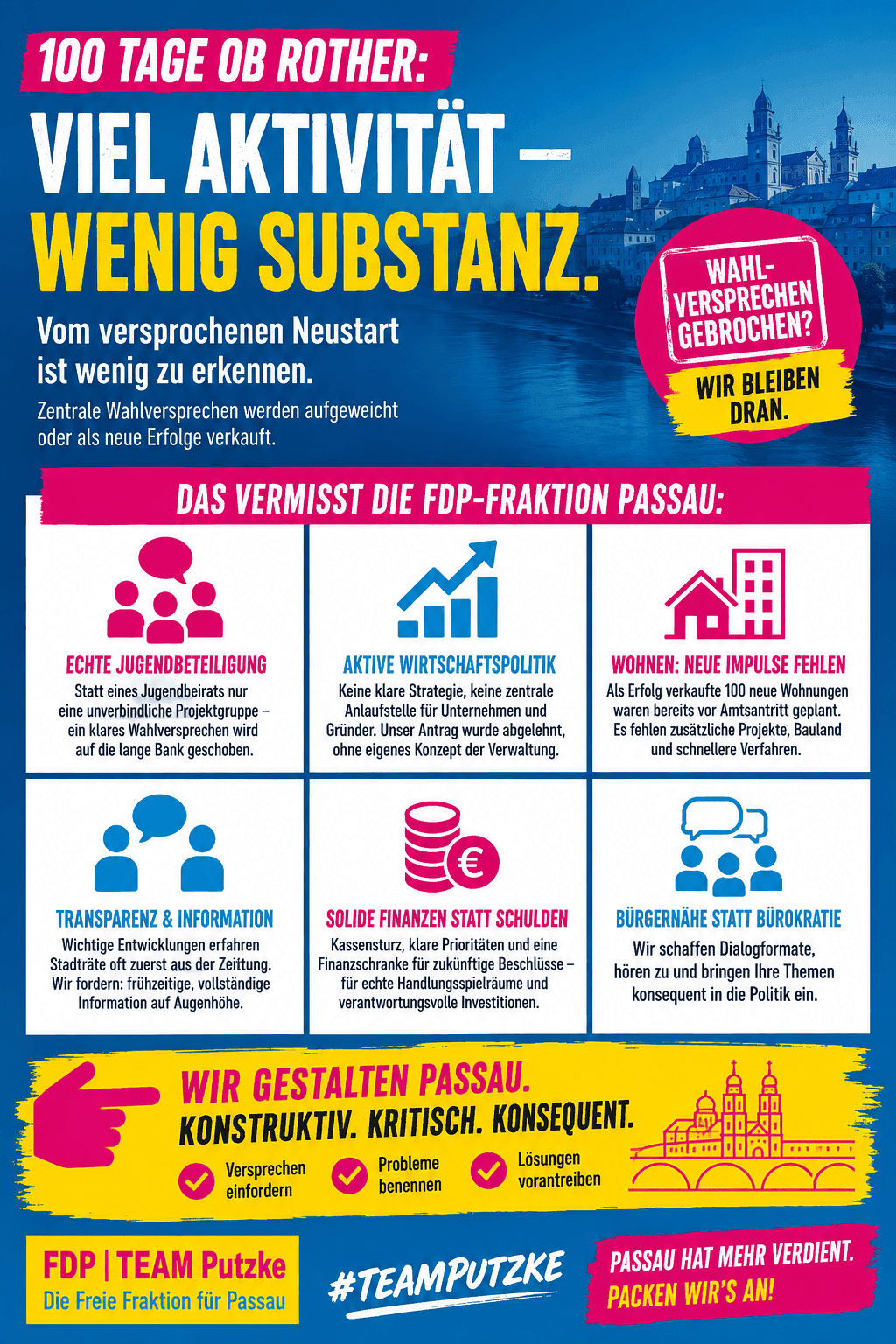
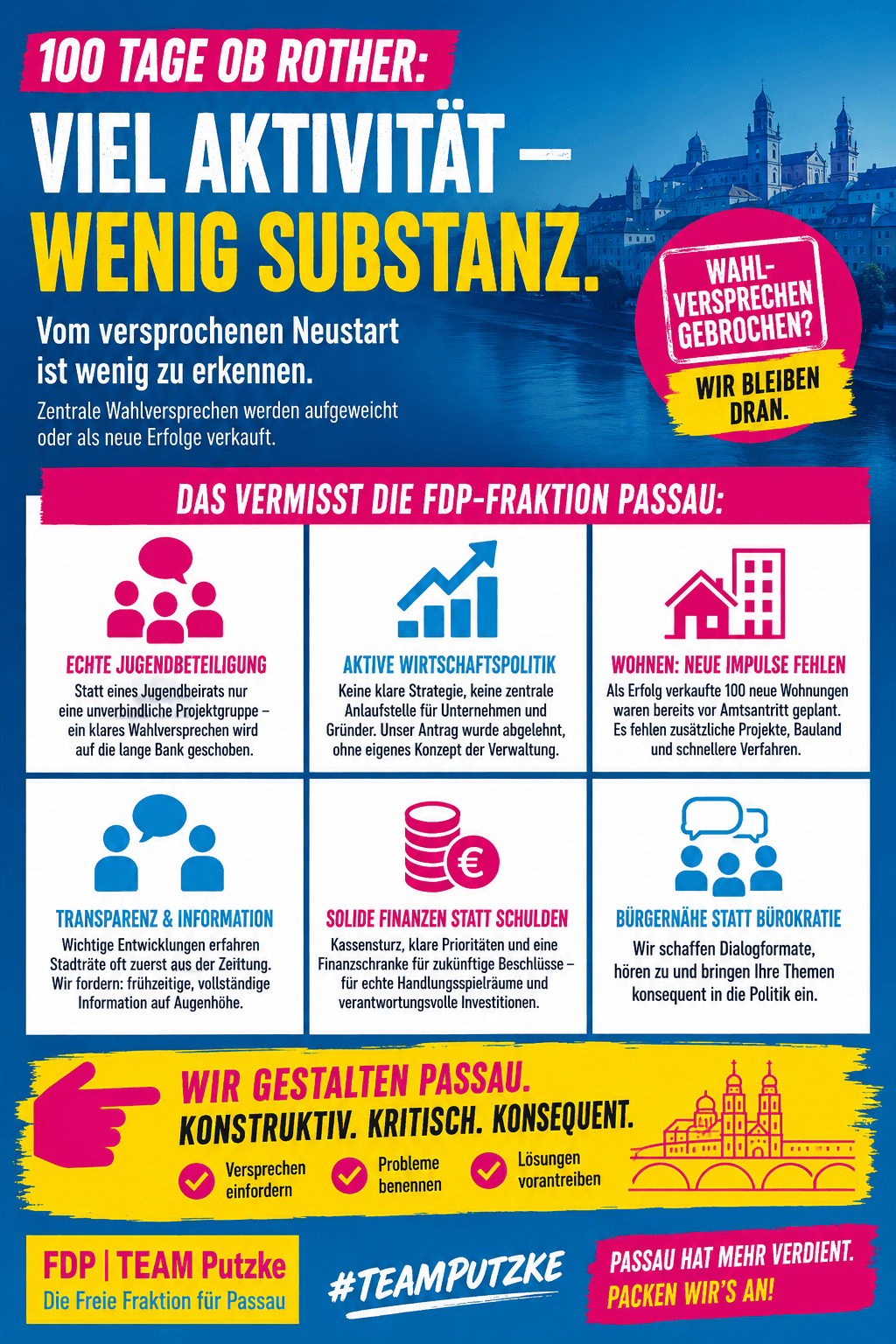
The handling of key election promises is particularly disappointing, according to the group. These include the greater involvement of young people announced during the election campaign. Almost all the mayoral candidates had spoken out in favour of reintroducing a youth parliament or youth council. Hardly anything of this has remained since the election.
“Instead of a democratically legitimised youth council elected by young people, a non-binding project group is now to be set up first. This means a clear election promise is being kicked into the long grass and hollowed out,” criticises deputy FDP group chairman Sebastian Frankenberger. “A youth commissioner appointed by the city council cannot replace an independent participation body. Youth participation means giving young people a voice of their own – not speaking on their behalf.”
The FDP group had therefore called for the establishment of a genuine youth council and a youth policy spokesperson. The interim solution that has now been adopted may postpone binding participation until well into 2027. “Anyone who promises a youth council during the election campaign must not sell a working group as an equivalent substitute after the election,” says Frankenberger.
The FDP also misses a clear line in economic policy. Organisational changes within the administration alone do not yet constitute an active location policy. The group has therefore called for a comprehensive economic and location strategy and a central point of contact for businesses, founders and investors.
“The motion was rejected in the economic committee, without the city administration having so far presented an overall written concept of its own,” explains deputy group chairman Prof. Georg Steiner. “Especially in view of developments on the former Eterna site, the PNP site and around the MedizinCampus Niederbayern, Passau needs a forward-looking strategy. Economic development must not consist of reacting to individual developments when they are already well advanced.”
The FDP is also critical of the housing policy record. To the group’s knowledge, the 100 new flats highlighted during the election campaign had already been planned or launched before the new Lord Mayor took office.
“Presenting projects from the previous administration as your own new departure is no substitute for a new housing policy,” stresses Steiner. “What would really matter is initiating additional projects, mobilising building land, speeding up planning procedures and thus genuinely providing new impetus.”
The FDP group also sees room for improvement in the flow of information between the town hall and the city council. For important projects and political decisions, the elected city councillors must be involved in good time and comprehensively. It must not become the norm that members of the city council first learn of significant developments from the newspaper.
“The city council is not a subordinate information body of the administration, but the elected representation of the citizens,” Putzke makes clear. “Transparency does not begin with press photos, but with open, early and complete information for the political bodies.”
At the same time, the FDP points to its own work in the first 100 days. The group has tabled numerous motions and enquiries on the economy, transport, housing, youth participation, transparency and closeness to citizens. With open group meetings and the “Three Rivers Dialogue”, it has also created new formats to involve citizens more closely in local political work.
“We are not in opposition for the sake of opposition,” explains Putzke. “We support sensible projects, but we also state just as clearly where election promises are broken, decisions are delayed or old projects are passed off as new successes. Our aim is to move Passau forward and to make politics in the town hall more transparent, more reliable and closer to citizens.”
The assessment after 100 days is therefore sobering. Lord Mayor Andreas Rother may convey a sense of busyness, but he must now show that this leads to concrete political results.
“A fresh start is not just a change at the top of the town hall,” Putzke concludes. “It requires the courage to make your own decisions, clear priorities and reliability in keeping election campaign promises. After 100 days, too little of this can be seen. The announced new departure must not turn into mere business as usual with a new face.”
The post 100 Tage OB Andreas Rother: Vom versprochenen Neustart ist wenig zu erkennen first appeared on FDP Fraktion | TEAM Putzke.